Interpretation and common mistakes · DP103
Reading a privacy law update without mistaking a draft for a rule
A source-checking method for distinguishing drafts, final rules, commencement notifications and textual corrections.
Research cutoff: . This dated explainer is general information; check the linked instruments and your circumstances before acting.

Imagine receiving a forwarded message that says “new DPDP rules are live” and asks every team to replace its consent forms by Friday. Before turning that message into a project, establish what was published and what became effective. A draft, a final rule and a commencement notification have different functions.
This article uses a research cutoff of 22 October 2026. The final Digital Personal Data Protection Rules, 2025 were notified in November 2025 and provide for staged commencement. Describing them as an unfinalised draft at this cutoff is inaccurate. Describing every substantive duty as already in force is also inaccurate.
Find the instrument behind the headline
Ask for the official document, its issuing authority, title, notification number and publication details. Read the operative text rather than relying only on a summary. A consultation document may invite comments on proposed wording; a final notification establishes the adopted wording, subject to its commencement terms.
The relevant Act provisions and Rules can have separate commencement instruments. For DPDP, the Act commencement notification needs to be read alongside rule 1 of the final Rules. A team that checks only the year printed in the Act’s title will miss the implementation sequence.
Save the document used for the assessment and its retrieval date. This helps explain later why a policy decision was made, especially when an online page subsequently points to a corrected version.
Separate publication from commencement
At the cutoff, institutional provisions have already commenced, the Consent Manager registration phase is scheduled for 13 November 2026, and most substantive business duties and rights are scheduled for 13 May 2027. The instruments express the later phases as periods from publication; an official May 2026 ministry communication also identifies the May 2027 implementation date.
For deadline-sensitive advice, check the actual Gazette and relevant provision. The Gazette date, electronic identifier, website upload date and a later press-release date may differ. A social-media publication timestamp should not replace the legal commencement mechanism.
A readiness plan can begin before a duty commences. Label that work as preparation and identify existing laws that still need to be observed. Avoid turning a future date into a claim that personal data has no legal protection in the meantime.
Read corrections at their actual scale
The December 2025 corrigendum corrects wording and references in the final Rules. It should be incorporated into a current reading of the text. It does not support an assertion that the entire implementation programme was cancelled or that all deadlines restarted.
The October 2026 Removal of Difficulties Order makes particular textual corrections: the personal-data wording for a person with disability in section 9(1), and “data audit” in section 10(2)(c)(ii). It does not lower the statutory child-age threshold or accelerate the underlying substantive obligations.
This is a useful test for update writing. State the provision before and after the change, then explain the operational consequence that actually follows. If the correction does not require a redesigned workflow, say what document or reference needs updating instead of inventing urgency.
Convert a verified update into a small decision record
Consider a hypothetical education provider receiving a headline claiming that October’s order requires new parental verification immediately. Its reviewer retrieves the order, checks the two amended provisions and compares the commencement notification. The provider corrects its legal reference notes and keeps the substantive readiness project on its established schedule.
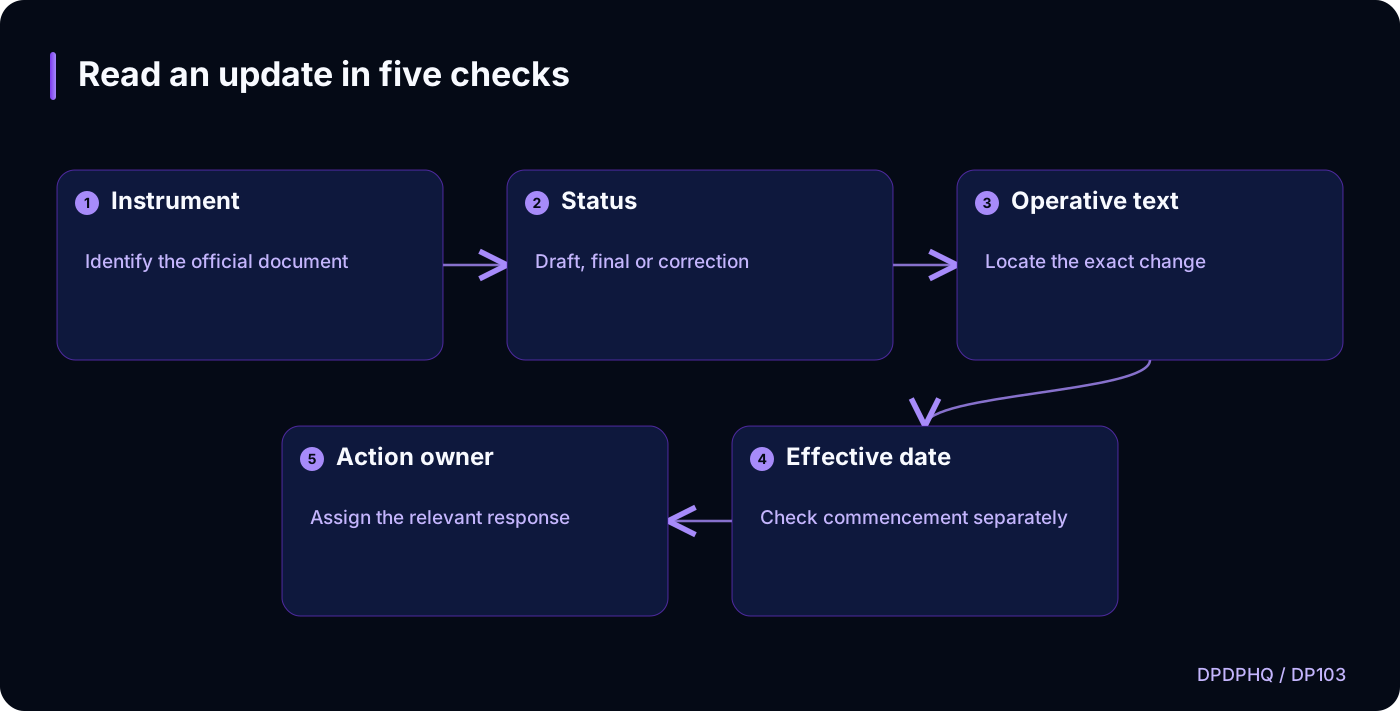
The decision record can contain five fields: official source, status, exact change, effective date and affected owner. Add an uncertainty field where interpretation remains unresolved. The purpose is to make a decision traceable, not to create a long legal digest for every department.
Send product teams the specific requirement that affects their work. Finance may need a budget implication; support may need a corrected explanation; the legal owner may simply need to update a citation. Not every update requires every team to act.
Keep absence of evidence distinct from evidence of absence
An enabling provision may permit a future notification about a class, country or exemption. Its existence does not prove that the notification has been issued. Conversely, failing to find an instrument in one search does not conclusively establish that none exists.
Record what was verified and where the search remains limited. Recheck before making a deadline-sensitive or business-critical decision. The failure to avoid is letting a confident summary outrun the document: the useful update is the one that accurately changes a decision, or accurately explains why no change is required.
Read an update in five checks
Text version of the diagram
- Instrument: Identify the official document
- Status: Draft, final or correction
- Operative text: Locate the exact change
- Effective date: Check commencement separately
- Action owner: Assign the relevant response
- Instrument → Status
- Status → Operative text
- Operative text → Effective date
- Effective date → Action owner
Sources and reading context
These references support the original 22 October 2026 research. Source links and the date above make the scope of this article explicit.
- Digital Personal Data Protection Rules, 2025 · Rule 1 and final notification
Final Rules and their staged commencement
- Commencement notification for provisions of the DPDP Act · Commencement notification
Separate commencement of Act provisions
- Corrigenda to the Digital Personal Data Protection Rules, 2025 · December 2025 corrigendum
Corrections to the final Rules
- Digital Personal Data Protection (Removal of Difficulties) Order, 2026 · October 2026 Removal of Difficulties Order
Specific corrections to sections 9 and 10
- National Consultative Workshop on Strengthening Cyber Security Frameworks for State Data · 16 May 2026 release
Official communication corroborating the substantive implementation date